Open Humanities Pres, book, ISBN 978-1785421433, English, 416 pages, 2025, UK
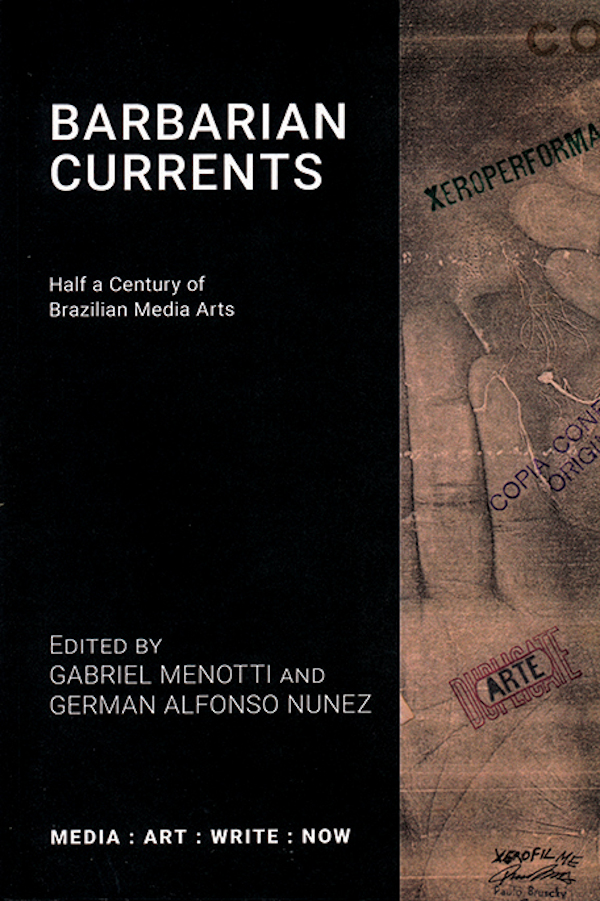
History requires context to connect facts and events, and art history equally needs context to understand art movements, artists, and artworks. This is one of the core values of the Entangled Traditions research project, which Gabriel Menotti led for over five years, reconstructing and contextualising the mapping of the history of New Media and Computer Arts in postwar Brazil. This comprehensive anthology, edited together with German Alfonso Nunez, is structured into four thematic sections: code and language, social communication systems, moving images, and personal computers. The first section is driven by the Concretism movement, which was already being acknowledged abroad while the country was under a military dictatorship. Key texts by authors such as Augusto de Campos, Waldemar Cordeiro, and Walter Zanini are included from the 1950s to the 1970s. The second section discusses artists working with uncensored communication and networks during totalitarian times, enabling a “systemic awareness”, with texts by Eduardo Kac, Frederico Morais, and others. The third section focuses on analogue audiovisual productions as a moment of renaissance after the return of democracy, with contributions by Lucas Bambozzi, Solange Farkas, and others. The fourth and final section comprehensively reconstructs the impact of the personal computer on Brazilian media art in a new social and political context, with texts by Arlindo Machado, Christine Mello, and others . The editors argue that art and technology have been used in Brazil as a decolonisation strategy, and this book maintains the fragmentation of Brazilian media art as a consistent approach. Most of the texts have been translated into English for the first time, which makes this work, if possible, even more valuable.