CD – Cronica
The fact that the cities ceaselessly pulsate, breathe, and transform is one of the founding insights of modernity. As early as 1926, with Le Paysan de Paris, Aragon—a surrealist writer and poet—rendered an image of the urban environment as an autonomous organism, made of signs, implicit noises, and friction, animated by a restrained, highly imaginative, and powerful energy. The city thus ceases to be a simple container and becomes a living and unstable entity, in constant shift, capable of producing meaning through its own internal tensions and zones of friction. Emiter’s work is situated along this same line, a project that transfers that intuition from the plane of the gaze to that of the listener. The city becomes a constantly rewritten electroacoustic score: a web of impulses, feedback, and sonic densities that convey the idea of a veritable organism. Through the use of electronics and field recordings, the urban environment is not represented, but rather explored in its less obvious flows, as if sound were a sensitive instrument of investigation, capable of making audible dynamics normally hidden from everyday listening. This creates a dimension where space, matter, and noise merge into a single vibrant, elusive, and never-quite-decipherable body. In Electromagnetism of the City, this research focuses on urban sound environments meant as complex systems, characterized by nonlinear relationships, overlapping frequencies, and constant shifts in perceptual scale. The city appears as a diffuse electromagnetic network, where each element contributes to generating a perpetually transforming force field, more intuitive than rigorously analyzable. The opening composition, which also lends its title to the release, forms a long suite in which the urban landscape unfolds obliquely through mutations, buzzes, and micro-events that emerge and reabsorb without hierarchies, suggesting a listening experience conducted from within the urban meanders and its invisible infrastructures. Time expands, and attention is drawn to minimal variations, imperceptible shifts, and slow buildups of tension, rather than traditional narrative developments. After this initial immersion, the work unfolds into shorter episodes that offer different vantage points on the urban ecosystem, like shifts in focus or subtle perspective shifts. The sound oscillates between abstract rarefactions and more material concentrations, between subtle repetitions and circular structures that recall, without overtly declaring it, a lateral and oblique minimalism. Vocal residues, rhythmic hints, and irregular textures emerge, introducing a more corporeal and fragile dimension. The discourse closes, gradually drawing attention to a more intimate dimension, like a distant echo of the initial suite, leaving on hang the idea of a city that continues to vibrate beyond our hearing, even when the sound seems to have faded.
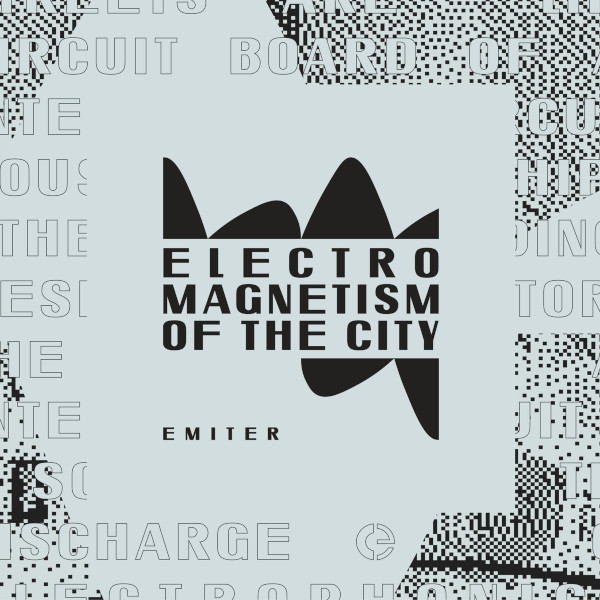
Emiter – Electromagnetism of the City