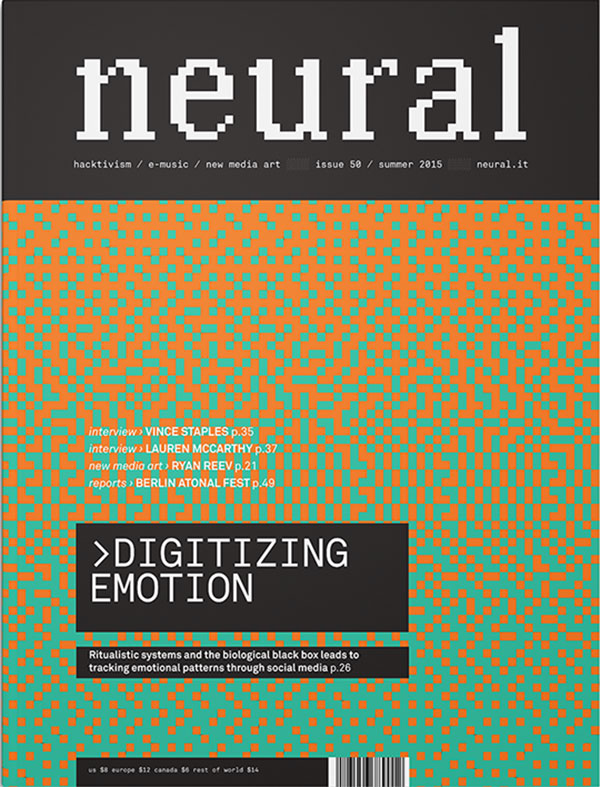
Sometimes the online world reveals unsuspected parallel dimensions. This is an unknown restyle of Neural independently (and secretly as we never knew about it) made by NY-based Motion and Graphic Designer, Clarke Blackham. Very nicely made, perhaps only a bit glossier for the magazine’s line, it testifies once more how even your most familiar outcomes can have another life somewhere else.
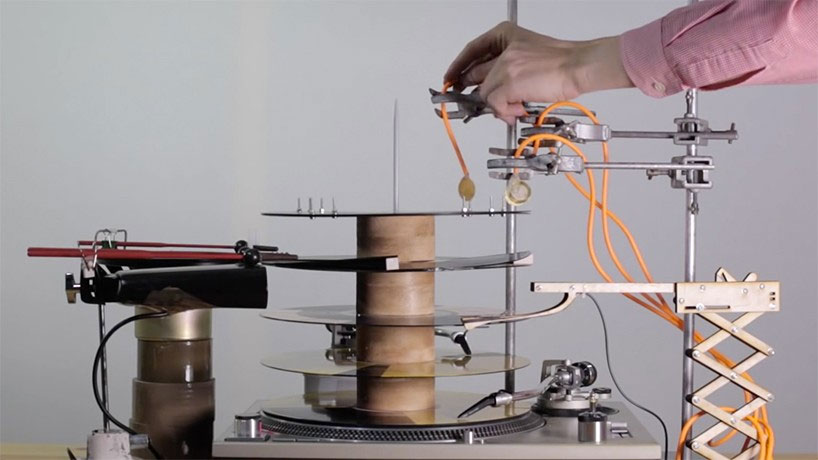
The value of craft after software sounds rampant sometimes, expressing the freedom of escaping repetitive taps and clicks to accomplish some assumed tasks. Mixing media, electricity, electronics, mechanics and inert objects Graham Dunning has realised a structured track/performance/open script in his “Mechanical Techno: Ghost in the Machine Music.” More than a proof of concept a machine music declination.
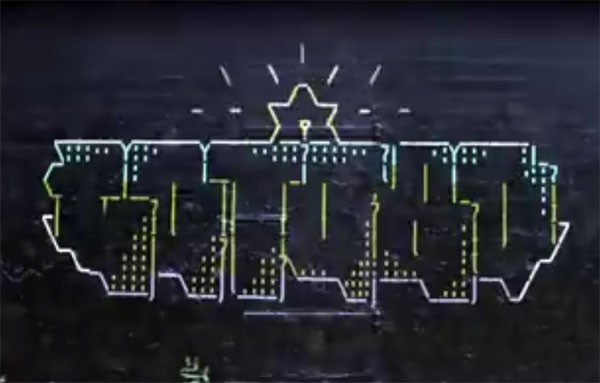
Isn’t ASCII Art a perfect form of “graffiti” in 2010s? The 8-bit aesthetics is among the strongest visual references connecting the analogue recent past with the omni-digital present, so why not adopt it to finally have some public art embedded in the present? In Varberg, Sweden, 2016, the GOTO80 crew (feat: Karin Andersson) did it, choosing (not by accident) the Mo Soul Amiga-font.
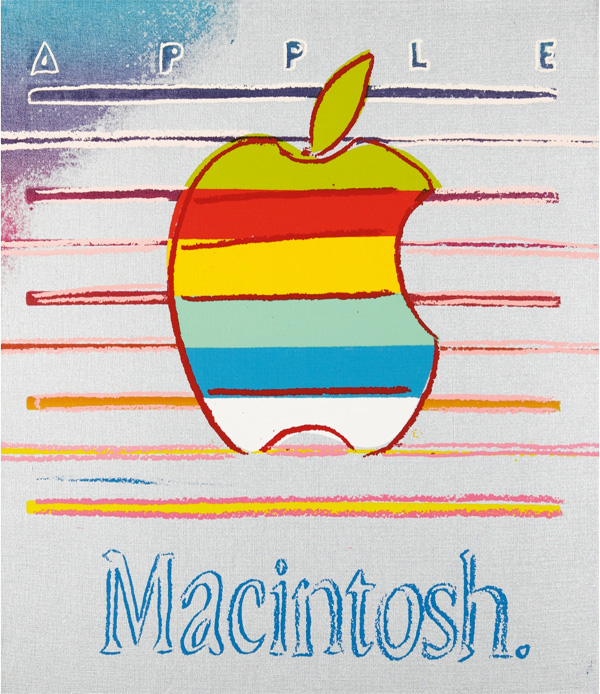
The relationship between Andy Warhol and personal computers (becoming quite popular during his last years) has been only partially investigated beyond his Amiga works. In November 2015, Sotheby’s sold his “Apple (from Ads)” (acrylic and silkscreen ink on canvas) for 910.000 USD, and in catalogue’s notes Warhol tells about his meeting with Steve Jobs insisting to give him one and showing him how to draw (even if still in black and white): “we went into Sean [John Lennon’s son]’s bedroom–and there was a kid there setting up the Apple computer that Sean had gotten as a present, the Macintosh model. I said that once some man had been calling me a lot wanting to give me one, but that I’d never called him back or something, and then the kid looked up and said, ‘Yeah, that was me. I’m Steve Jobs.’ And he looked so young, like a college guy. And he told me that he would still send me one now. And then he gave me a lesson on drawing with it. It only comes in black and white now, but they’ll make it soon in color…I felt so old and out of it with this young whiz guy right there who helped invent it.”
Harsh Noise Wally, is a sophisticated mashup mixing strips of Wally, the lazy and cynic colleague of Dilbert with some epic noise music extreme attitudes. Well conceived and assembled.
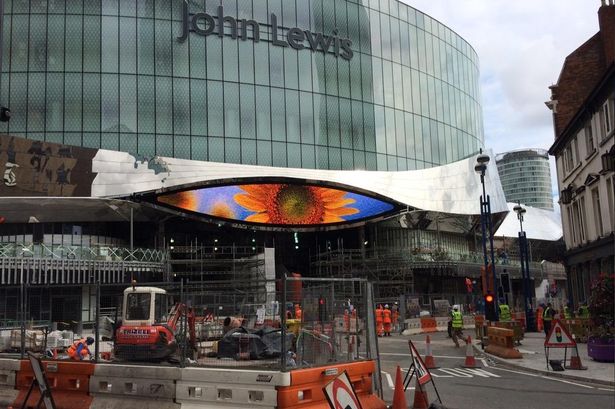
Minority Report comes closer… Three huge screens at Birmingham New Street railway station are scanning passers-by and play advertisements accordingly. http://www.birminghammail.co.uk/news/midlands-news/new-street-station-advertising-screens-9920400
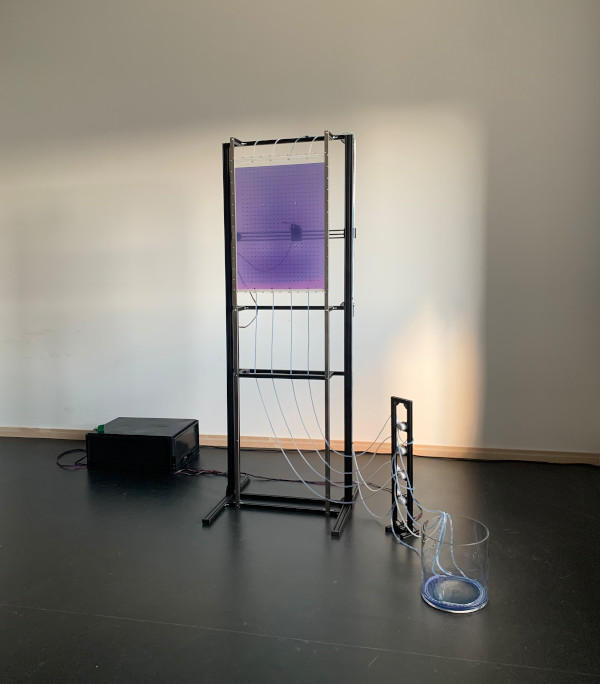
Anthofluid, to become is to be infiltrated, malleably fluid
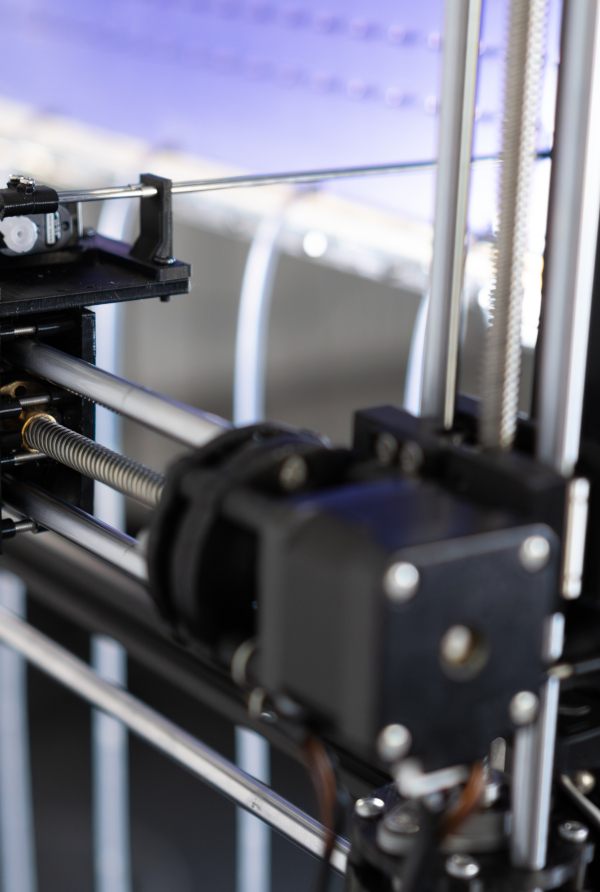
Part automated system, part moving image, Nathalie Gebert’s Anthofluid is a sculptural device that generates an ephemeral pictorial proposition at regular intervals. Using medical tubing, the assembly of transparent wafers that form its surface is gradually filled with a purplish liquid. A micro-controlled electromechanical system is then activated to transmit electrical impulses, arbitrarily distributed over the surface covered with electrical receptors. Each pulse then results in a chemical reaction that tints the liquid with a dual green and red hue, slowly mixing and fading to violet. The liquid is in fact a fluid solution of anthocyanin, a water-soluble natural plant pigment. The whole process refers to the hydrofeminist perspective – notably via the theories of Canadian researcher Astrida Neimanis – which reflects on the question of identity and corporeity through the aqueous lens. Underlying this is the idea of ‘becoming a body of water’, and thus a fluid, unstable and indeterminate body. An adaptable body with undefined, flexible contours that has the capacity to incorporate and become incorporated into its environment. Anthofluid also resonate with the ‘new materiality’ movement, a current of contemporary philosophy that emerged in the 1990s (in the wake, among others, of the research of feminist philosopher Rosi Braidotti) and which, in particular, calls into question the human/non-human, nature/culture duality. Indeed, Gebert’s work thwarts this opposition by the enhancement of the invasive dimension of water, as well as by diverting the Cartesian expectations suggested by its almost industrial materiality and the exactitude of its operational mechanics: the methodical electrical impulse transmitted to a precise point on the grid is instantly transmuted into volatile volutes, definitively escaping the rational logic that precedes it. The principle of dissolution becomes one of becoming.